


Closing small business deals may be likened to a sprint. Closing an enterprise deal, on the other hand, can be compared to running a marathon with checkpoints, many barriers to surmount, and a panel deciding whether you should reach the finishing line.
Ever wondered why it takes just a few weeks for some B2B sales deals to close while it takes months, sometimes an entire year, for others to complete? The secret behind all this can be found in the enterprise sales process.
For instance, I recall talking to a software entrepreneur who managed to secure numerous small clients shortly after starting the sales process. Filled with hope and confidence, he thought he could close deals at an enterprise level without realizing that the entire process is completely different from selling to smaller firms. After six months of meetings, discussions, and other related activities, he learned that selling to enterprises is not like selling to regular customers.
An enterprise sales process is a specific way in which enterprises sell high-cost solutions to potential clients. It is distinct from conventional sales because it is a much more complex process that involves various parties.
What Is an Enterprise Sales Process?
The enterprise sales process refers to the methodical process by which companies generate leads, engage, nurture, and eventually convert large organizations into paying customers.
Characteristics associated with enterprise sales include:
- Large contract sizes
- Long sales cycles
- Several decision makers involved
- Customized solutions
- Lengthy negotiations
- Relationship building
In contrast to persuading a single person to make a sale, enterprise sales reps often require buy-in from executive leaders, departmental leaders, procurement officials, financial officers, and technologists.
Imagine trying to sell a home compared to selling a skyscraper. Both transactions, but worlds apart in their complexity.
Why is the Enterprise Sales Process Important?
Organizations do not buy on the spur of the moment.
They take risks into consideration because the purchase affects more than one department and might entail substantial costs.
The enterprise sales process enables companies to:
- Make sales predictable
- Develop better client relationships
- Minimize sales cycles
- Make larger deals
- Close more sales
- Minimize sales inefficiencies
Salespeople may easily lose steam when negotiating deals and getting them approved without having a process.
Enterprise Sales vs Traditional Sales
Understanding the difference between enterprise sales and traditional sales is essential.
| Factor | Enterprise Sales | Traditional Sales |
| Deal Value | High | Low to Medium |
| Sales Cycle | Several months | Days or weeks |
| Decision Makers | Multiple stakeholders | Usually one person |
| Customization | Extensive | Limited |
| Risk Level | High | Lower |
| Relationship Building | Critical | Helpful but less complex |
Enterprise selling focuses heavily on trust, long-term partnerships, and business outcomes.
8 Key Stages of the Enterprise Sales Process
1. Prospecting
Any successful enterprise deal starts with targeting the right prospects.
This includes companies that:
- Match your target customer
- Have a problem that requires your solution
- Are financially capable of investing
- Are able to make decisions
Today’s enterprises have access to tools like:
- CRM systems
- Conferences
- Networking opportunities
- Account-Based Marketing (ABM)
Quality trumps quantity in B2B sales. A single qualified prospect is better than hundreds of leads.
Building a strong professional network can also help salespeople discover valuable prospects and create meaningful business connections.
2. Lead Qualification
Not all prospects are ready for purchase.
Lead qualification helps determine whether your company is a good match before wasting precious time and resources.
Typical sales questions include:
- Budget
- Authority
- Need
- Timing
Your prospect may love your product, but if there’s no budget approval, the sale will never happen.
3. Discovery and Needs Assessment
This is when enterprise salespeople transform from mere sales people into business consultants.
What needs to be done is:
- Identify business problems
- Areas of operational inefficiency
- Business goals
- Current solutions in place
- Pain areas
Effective salespeople listen far more than they speak.
Understanding leads to developing trust.
4. Stakeholder Mapping
The most important part of the enterprise sale process is knowing who all the decision-makers are.
Some common decision makers in this category include:
- CEOs
- CFOs
- IT Managers
- Procurement Managers
- Department Heads
- End Users
Think about planning an event where all ten family members have to agree on where to go. That’s what it is like dealing with an enterprise buying committee.
Understanding their needs will help you communicate more effectively.
5. Solution Presentation and Demonstration
Now that you’ve gotten the requirements, let’s show them how your product solves their problems.
A good demo of an enterprise-level product should concentrate on:
- Results
- Profitability
- Increased efficiency
- Risk mitigation
- Scalability
It’s not about showing everything you’ve got.
It’s about making the connection between what you offer and their problem.
6. Proposal Development
In most cases, enterprise buyers need comprehensive proposals that cover such items as:
- Pricing models
- Implementation schedule
- Service level agreements (SLAs)
- Technical details
- Outcomes expected
A good proposal serves as a guide to further cooperation.
The proposal should be clear and professional, adjusted to the buyer’s specific needs.
7. Negotiations
Negotiation is usually the most time-consuming part of enterprise selling.
Negotiation may concern:
- Changes to pricing
- Contract conditions
- Compliance issues
- Data protection matters
- Support services
Patience is required at this stage.
Enterprise buyers need assurance that their choice is the correct one.
Good negotiations should concentrate on added value.
8. Close and Onboarding
After the deal is closed through agreements, the process of closing begins.
But that does not mean the enterprise sales process stops here.
Onboarding helps in:
- Faster adoption
- Enhance customer satisfaction
- Decreasing churn
- Upselling
The beginning of most enterprise success stories happens even after signing the deal.
Enterprise Sales Process Workflow
A normal process flow goes like this:
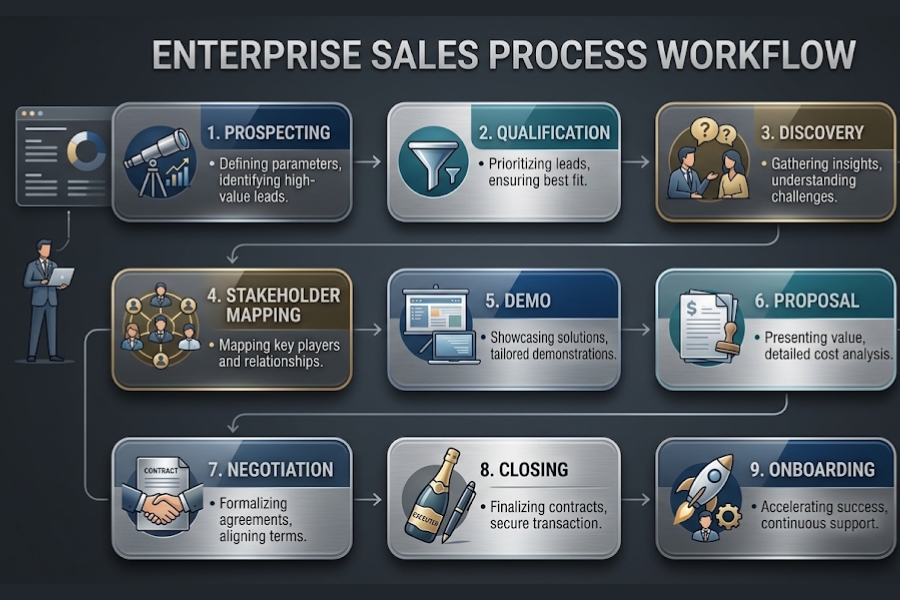
Following a structured workflow helps sales teams maintain consistency and accountability.
Common Challenges in Enterprise Sales
Lengthy Sales Process
The sales process may take anywhere from six months to a year or even more.
It is challenging to maintain motivation for such a long time.
Various Decision Makers
There will be various decision makers having varying interests.
Like for instance:
- CFOs are concerned about expenses
- IT departments are concerned about security
- Users care about usability
Negotiating between all of them calls for effective communication.
Complicated Procurement Process
Several companies have a complicated procurement process requiring many approvals.
Vendor Evaluations
Companies tend to evaluate several vendors before reaching a conclusion.
Best Practices for an Effective Enterprise Sales Process
Establish Relationships Early
Trust is at the heart of enterprise sales.
Make sure that you establish relationships before prospects start entering the buying cycle.
Focusing on Deliverables
Customers do not care about functionality but about what works.
Instead of saying:
“Our solution is built using the most sophisticated analytical tools.”
Say:
“Our solution can cut down your report generation process by 40%.”
Making Everything Personal
A generic presentation is rarely effective in enterprise sales.
Use Account-Based Selling Approach
Account-based selling strategy concentrates efforts on high-potential accounts as opposed to generic lead generation.
Conversion rate may increase thanks to this strategy.
Use Data to Make Decisions
Enterprises love data.
Offer:
- Case studies
- Return on investment calculations
- Testimonials
- Benchmarking
Enterprise Sales Tools That Improve Performance
Today’s sales teams depend on technology for managing their sales process.
The most commonly used software includes:
CRM Systems
Examples:
- Salesforce
- Hubspot CRM
- Microsoft Dynamics 365
Such applications monitor all interactions and business opportunities.
Sales Intelligence Tools
Examples:
- ZoomInfo
- LinkedIn Sales Navigator
- Apollo
Such software assists in identifying potential customers and key people involved.
Proposal Software
Examples:
- PandaDoc
- DocuSign
- Proposify
Such applications make the proposal process easier.
Revenue Intelligence Platforms
These solutions help analyze sales performance and forecast future revenue.
Enterprise Sales Process Example
Consider an example of a cybersecurity software company selling to a multinational bank.
The sales process would be something like this:
- Identify the bank as a target customer.
- Approach the IT heads of the bank through LinkedIn and events in the industry.
- Conduct discovery calls.
- Learn about compliance needs.
- Give customized demonstrations.
- Provide ROI projections.
- Discuss pricing and contracts.
- Conduct procurement reviews.
- Close deals.
This process may take several months but could result in a multi-million-dollar contract.
Trends of the Future in Enterprise Sales
The enterprise sales environment remains fast-changing.
Artificial Intelligence
How AI is aiding the sales process:
- Identification of new opportunities
- Forecasting buyer behavior
- Automation of tedious tasks
Data-Driven Selling
More organizations are using analytics to enhance decision-making and forecasting.
Account-Based Marketing
ABM is becoming popular since it brings the efforts of sales and marketing together around valuable accounts.
Remote Selling
Virtual meeting technology has become the norm in enterprise sales.
Conclusion
Enterprise selling is more than just a list of sales actions to take; it is a strategy that will allow a business to develop strong connections, overcome difficult problems, and make high-value sales to large companies.
While enterprise selling calls for patience and effort, the potential payoffs are huge. Using an efficient enterprise selling process from prospecting and qualifying to negotiating and onboarding will make the work more efficient and productive.
Being a salesperson, entrepreneur, or startup founder, you will benefit from learning the enterprise selling process.
FAQs
Q. What is an enterprise sales process?
An enterprise sales process is a structured approach used to sell high-value products or services to large organizations through multiple stages, including prospecting, qualification, discovery, negotiation, and closing.
Q. How long does an enterprise sales cycle usually take?
Enterprise sales cycles typically range from three months to over a year, depending on the deal complexity and number of stakeholders involved.
Q. Why is enterprise sales more complex than traditional sales?
Enterprise sales involves larger budgets, multiple decision-makers, customized solutions, procurement reviews, and longer approval processes.
Q. What skills are important in enterprise sales?
Key skills include relationship building, negotiation, communication, strategic thinking, stakeholder management, and problem-solving.
Q. What tools help manage the enterprise sales process?
Popular tools include Salesforce, HubSpot CRM, LinkedIn Sales Navigator, ZoomInfo, PandaDoc, and DocuSign.
Additional Resources
- HubSpot Sales Blog – Comprehensive guides on B2B and enterprise sales strategies.
- Salesforce Sales Resources – Best practices, research, and enterprise sales insights.
- Gartner Sales Research – Industry-leading research on enterprise buying behavior and sales effectiveness.